 Phone: +91-9654875195
 Email: sales@lcsindia.com


 HOME
HOME ABOUT US
 PRODUCTS
 QUALITY
 QUOTATION
 CLIENTS
 CONTACT US
 Products Range
 Combination Therapy (IFT+TENS+MS+US) LCS - 154S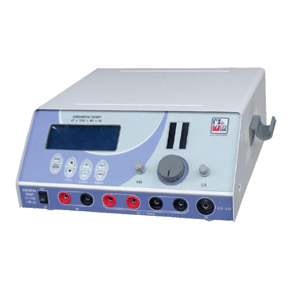
LCS Combination Therapy (IFT+TENS+MS+US) : A single workstation that houses Interferential Therapy (IFT), Transcutaneous Electrical Nerve Stimulation (TENS), Neuromuscular / Muscle Stimulation (MS) and 1 MHz Therapeutic Ultrasound (US) lets physiotherapists move smoothly from pain control to deep-heat tissue repair to active muscle re-education—without unplugging leads or wheeling in extra devices. That means less capital outlay, faster room turnover and a seamless patient experience.
- ■■■■■■■■■■■■
- Interferential Therapy (IFT)
Two medium-frequency currents (2 – 10 kHz) intersect in tissue to create a deep, low-frequency beat that delivers long-lasting analgesia and enhances circulation.
Ideal for: chronic low-back pain, cervical spondylosis, post-surgical edema, osteoarthritic joints. - Transcutaneous Electrical Nerve Stimulation (TENS)
Low-frequency pulses stimulate sensory nerves and trigger endorphin release, blocking acute superficial pain at the spinal gate.
Ideal for: incisional pain, tendinitis, neuralgia, labour analgesia. - Muscle Stimulation (MS)
Programmable square-wave or Russian currents evoke controlled contractions that prevent disuse atrophy and retrain neuromuscular pathways.
Ideal for: quad strengthening after ACL repair, foot-drop correction, post-stroke hemiparesis, spasm reduction. - 1 MHz Therapeutic Ultrasound (US)
Deep-penetrating acoustic energy (≈5 cm) produces thermal and micromassage effects that boost blood flow, increase collagen extensibility and accelerate healing.
Ideal for: chronic tendinopathy, capsular fibrosis, plantar fasciitis, deep muscle trigger points.
- Sequential care without repositioning —warm tissue with 1 MHz ultrasound, switch to IFT for analgesia, finish with MS to activate weak musculature, all in the same session.
- Space & cost efficiency —four core modalities, one footprint, one purchase order.
- Unified interface & presets —rotary-encoder control and shared protocol library shorten staff training and streamline documentation.
- Higher patient compliance —fewer machine swaps mean shorter appointments and a more professional treatment flow.
Specifications LCS - 154S :
| Dimensions (L*H*D) | 240mm, 280mm, 100mm |
| Weight | 2.8 kg Approx. |
| Operating Voltage | 110V - 220V 50Hz / 220V for US |
| Absorption | 50 Watts |
| Fuse | 1 Amp |
| Room Temperature | 10° to 40° C. |
| Moisture | 10% to 80% |
| Display | LCD |
| Preset Program | 100 |
| Customise User Program | 99 |
| Max out-put Current | 100mA for CH1 & CH2 |
| Carrier Frequency | 2, 2.5, 4, 6 ,8 , 10 KHz |
| Base Freq. | 0-250 Hz |
| Sweep Freq. | 0-250 Hz |
| Therapy Mode | 4 Pole Classic, 4 Pole Vector, 2 Pole Modulated |
| Modulation in 2PM | 10 to 100 % |
| Sweep Wave Shape | TRA, TRI, REC |
| Vector Mode | 2PL, 4PL, 4PT, 4PNL |
| Output Power Feedback System | Available |
| RUSSIAN CURRENT | |
| Carrier Freq. | 2.5K hz |
| Base Freq. | 0-250 Hz |
| Sweep Freq. | 0-250 Hz |
| DIADYNAMIC CURRENT | |
| Current Mode | CP, LP, DF, MF |
| Freq. | 50 & 100 Hz |
| TENS | |
| Tens Mode | Cont., Burst, Sweep, PWM, Amplitude, Random, Conventional, Acupuncture, Biphasic |
| Tens Freq. | 1 to 250 Hz (in steps of 1 Hz) |
| Tens Pulse Width | 50 to 1000 uS (in steps of 50 uS) |
| Tens Burst Freq. | 1 to 10 Hz (in steps of 1 Hz) |
| Tens Max Output Current. | 100 mA |
| MS | |
| Interrupted Galvanic Modes | Diagnostic & Theraputic |
| Diagnostic Wave Shape | Rectangular & Triangular |
| Diagnostic Freq. | 0.5, 1 & 3 Hz |
| Diagnostic Pulse Width/Duration | 0.01, 0.03, 0.1, 0.3, 1, 3, 10, 30, 100, 300 mS |
| Theraputic Wave Shape | Rectangular & Triangular |
| Theraputic Freq. | 0.5, 1 & 3 Hz |
| Theraputic Pulse Duration/Width | 50, 100, 150, 200, 250, 300 mS |
| Galvanic | Plane (DC) |
| Surge Faradic Freq | 50 Hz |
| Surge Time (on/off) | 1 to 9 Sec. |
| Plane Faradic Freq. | 100 Hz |
| US | |
| US Freq. | 1 MHz |
| Max Output in Cont. Mode | 2 W/cm2 |
| Max Output in Pulse Mode | 3 W/cm2 |
| Pulse Freq. | 1 to 100 Hz Adjustable |
| Duty Cycle (PW) | 1 to 99 % (in steps of 1 %) |
| Treatment Time | 1-99 Min |
Key Clinical Benefits
- Quad-modal versatility — deep analgesia with IFT, surface pain gating with TENS, active muscle re-education via MS, and tissue-heating / micromassage with 1 MHz ultrasound.
- Flexible pairing — run any two or even three modalities together (IFT + MS + US, TENS + MS + US, etc.); the only restriction is that IFT and TENS cannot run at the same time.
- Custom pulse-width TENS, adjustable MS duty cycles, and selectable ultrasound pulse ratios let therapists fine-tune protocols from acute injuries to chronic tendinopathies.
- Two isolated channels treat bilateral or agonist–antagonist muscle groups simultaneously with the same electro-modality, cutting chair-time in half.
- Do not use over pacemakers, cardioverter-defibrillators or the anterior neck.
- Avoid abdomen & pelvis during pregnancy; ultrasound is also contraindicated over the uterus.
- Do not treat malignant tissue, active infection, thrombophlebitis or open wounds.
- Ultrasound: avoid growth plates in children and areas with reduced thermal sensation.
- Real-time impedance feedback for IFT drops current to zero if pad contact is lost.
- Automatic power compensation keeps dose stable throughout therapy.
- One-touch Probe-Test instantly flags faulty leads or electrodes—demo at 10 : 10.
- 1. How is the LCS-154S different from the LCS-153S?
- The 154S adds Muscle Stimulation (MS) to IFT, TENS and 1 MHz ultrasound, giving therapists four core modalities in one unit.
- 2. Which modality combinations can run simultaneously?
-
You can pair or even triple-stack everything except IFT + TENS.
Permitted examples:
• IFT + MS • IFT + US • IFT + MS + US
• TENS + MS • TENS + US • TENS + MS + US
• MS + US
The unit blocks only the IFT + TENS combination for safety and signal integrity. - 3. When should I use ultrasound first?
- Apply 1 MHz ultrasound to warm deep tissues and increase blood flow; follow with IFT for analgesia or MS for muscle activation.
- 4. How does the Probe-Test feature work?
- Press PROBE TEST; a micro-pulse checks cable and pad integrity. PASS / FAIL appears within seconds.
- 5. Is the LCS-154S hospital-grade?
- Yes—ISO 13485 manufacturing, CDSCO registration, and an aluminium sub-frame with SMT electronics ensure long service life.